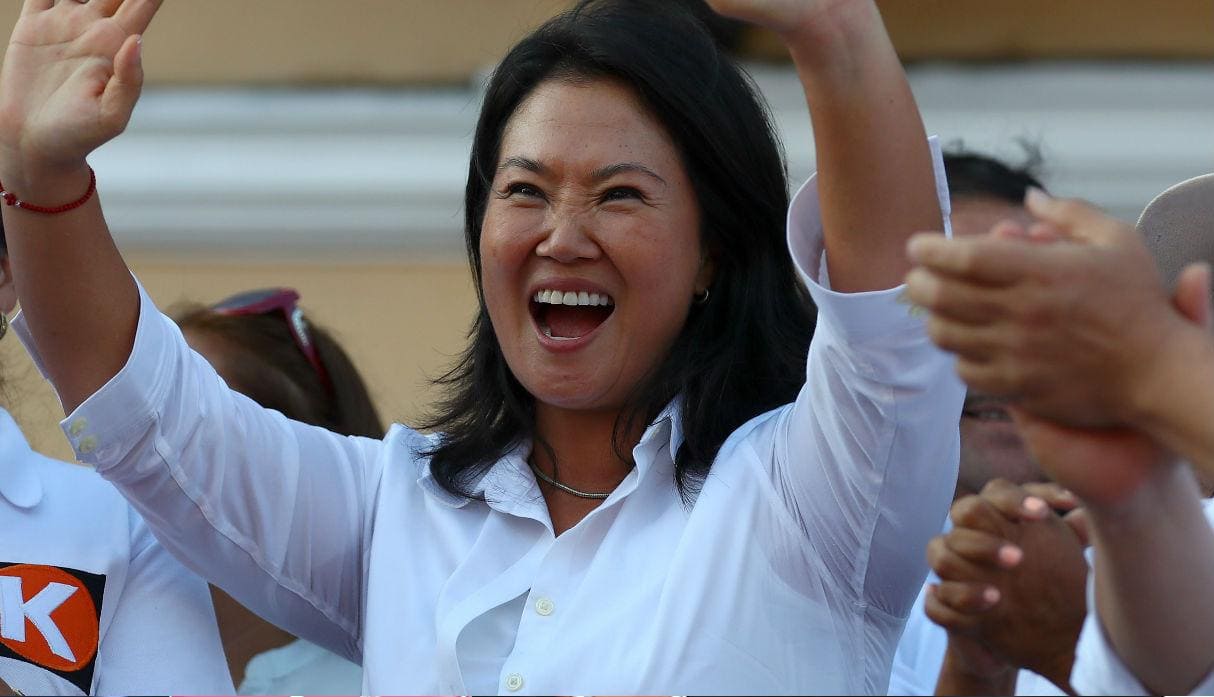
Keiko Fujimori took office as President of Peru on 28 July 2026. She arrives with the Cócteles case dismissed, but with three open investigations that the Constitution freezes while she governs. This piece does not follow the judicial decisions, but the money. It reconstructs how much entered her 2011 and 2016 campaigns and from where, according to prosecutors. It explains how it was disguised with sham donors and what share went unaccounted for. It also clarifies why the Constitutional Court left all of that unpunished. Finally, it reviews the flows still under investigation: the 2021 campaign, the Alas Peruanas money and her personal assets. The analysis by fronts is in Keiko Fujimori’s case file at Auditoría Abierta.
The short answer. The money of Keiko Fujimori’s campaigns has been counted, but not punished. Prosecutors traced some US$3.65 million in cash from Dionisio Romero, US$1.2 million from Odebrecht via Jaime Yoshiyama and US$480,000 collected by José Chlimper. They concluded that the party accounted for only 33 % of what it raised in 2011 and 2016. The defence itself admitted at trial the use of sham donors. However, the Constitutional Court annulled the trial in October 2025 and dismissed the charges in January 2026. That financing was not an offence at the time. Romero’s money now returns as an illicit enrichment investigation, frozen while she is president.
Who Keiko Fujimori is and why her case matters in October 2026
Fujimori won the 2026 run-off by 49,641 votes over Roberto Sánchez. It was her fourth attempt. She takes office with 69 prosecutorial investigations in her record, 51 dismissed and 18 ongoing, almost all born of the Cócteles case.
Her case matters for this series because it is the best example of proven money without a crime. Prosecutors reconstructed amounts, names and mechanisms. The Constitutional Court did not dispute that reconstruction. It said the law of 2011 and 2016 did not punish it. The same turn benefited Pedro Pablo Kuczynski and Ollanta Humala. Bajo Lupa also publishes a fact-check on whether she was acquitted in the Cócteles case.
Timeline of Keiko Fujimori’s money, decision by decision
| Date | Body | Decision | Evidence level |
|---|---|---|---|
| November 2010 to May 2011 | Dionisio Romero | Delivery of some US$3.65 million in cash, according to prosecutors | Under investigation; no verdict |
| December 2010 | Fuerza 2011 | Two cocktail fundraisers declared at some US$119,750 and US$90,000 | Declared to the ONPE |
| 2011 | Odebrecht, via Jaime Yoshiyama | US$1.2 million for the campaign, according to Jorge Barata (2019) | Cooperating witness testimony |
| September 2011 | ONPE | Records income of just over S/17 million with transfers of unidentified origin | Official record |
| 2016 | José Chlimper | US$480,000 in five deliveries, destination not established | Under investigation |
| 2018 | Money Laundering Prosecutor’s Office | Concludes the party accounted for only 33 % of what it raised in both campaigns | Prosecutorial report |
| October 2018 to 2019 | Judge Richard Concepción Carhuancho | Preliminary detention and pre-trial detention; more than 13 months in custody | Precautionary measure |
| 1 July 2024 | Trial court | Cócteles trial begins against 46 defendants | Proven |
| 2024 | Fuerza Popular defence | Admits at trial the use of sham donors | Own admission |
| 30 September 2025 | Money Laundering Prosecutor’s Office | Formalises investigation over the 2021 campaign contributions | Preparatory investigation |
| October 2025 | Constitutional Court | Annuls the trial over procedural defects by prosecutors | Final |
| January 2026 | Constitutional Court | Orders the dismissal of the laundering and criminal organisation charges for 2011 and 2016 | Final |
| 4 February 2026 | Lima Anti-Corruption Prosecutor’s Office | Opens an illicit enrichment investigation over Romero’s US$3.6 million | Investigation |
| 28 July 2026 | Fujimori | Takes office as president; Article 117 limits the investigations | Proven |
2011: the cocktails, the raffles and the US$17 million
In September 2011, the ONPE recorded that Fuerza 2011 declared income of just over S/17 million for the campaign, according to RPP. There was a high volume of transfers of unidentified origin. The party explained part of that money with two events in December 2010. One cocktail fundraiser allegedly raised some US$119,750 and another some US$90,000. Prosecutors have maintained since 2014 that those cocktails and raffles could not finance a campaign of that scale. Behind them was allegedly a network of «sham donors» or «smurfing»: businesspeople who lent their names to conceal the real origin of the money.
That mechanism was admitted. According to El Comercio, Fuerza Popular’s own defence acknowledged at trial the use of sham donors. However, it denied that this constituted money laundering. Former congressman Rolando Reátegui, a cooperating witness, described how he recruited false donors in San Martín at the leadership’s request, according to Epicentro.
Dionisio Romero’s US$3.65 million
The largest individual flow is that of Dionisio Romero, chairman of Credicorp. According to prosecutors, he delivered some US$3.65 million in cash between November 2010 and May 2011, according to Resumen Latinoamericano and Infobae. Alongside him appears Juan Rassmuss, of Sudamericana de Fibras. This money now has a second judicial life. On 4 February 2026, weeks after the Cócteles case was dismissed, Lima’s First Anti-Corruption Prosecutor’s Office opened a new investigation, according to Infobae. The offence: illicit enrichment. Prosecutors note that her sworn asset declarations of 2010 and 2011 as a congresswoman barely changed despite those funds. Unlike the dismissed case, which focused on the party, this investigation examines her personal assets. It is classed as complex, with an initial term of eight months, and has no charges.
Odebrecht’s million via Yoshiyama
In February 2019, Jorge Barata, Odebrecht’s former representative in Peru, testified before Peruvian prosecutors, according to RPP. He said the construction company contributed US$1.2 million to the 2011 campaign. The channel was Jaime Yoshiyama, a former minister under Alberto Fujimori. Marcelo Odebrecht’s notebook, revealed in 2017, included a note about «increase Keiko», according to El Comercio. On 16 September 2026, now president, Fujimori appointed Yoshiyama, José Chlimper and Arsenio Oré to an Advisory Commission of the Presidential Office. La República reported it. With the case dismissed, none of them faces current charges over Cócteles.
2016: Chlimper’s US$480,000 and the 33 %
In the 2016 campaign, José Chlimper, then secretary general of Fuerza Popular, allegedly collected US$480,000 in five deliveries, according to Resumen Latinoamericano. The final destination was not established in the file. A 2018 report by the Money Laundering Prosecutor’s Office went further. The party could only account for 33 % of the money raised in total for both campaigns. In other words, two out of every three soles had no documented explanation.
Why all that money went unpunished
The trial began on 1 July 2024 against Fujimori and 45 other people, according to Infobae. Prosecutors sought 30 years and 10 months for her former advisers Pier Figari and Ana Herz. In October 2025, the Constitutional Court annulled the proceedings over the multiple corrections to the prosecution’s indictment, according to La Válvula. It did not rule on whether the irregular financing existed. In January 2026 it ordered the laundering and criminal organisation charges dismissed. The reasoning, according to El Comercio: in 2011 and 2016 irregular party financing was not a stand-alone offence. That offence came into force in 2019. Nor was a criminal organisation proven. It is the same criterion that freed Ollanta Humala, whose money trail is published by Bajo Lupa Digital.
2021 and Alas Peruanas: the flows still open
Two more trails remain under investigation. The first is the 2021 campaign. On 30 September 2025, the Money Laundering Prosecutor’s Office formalised an investigation against Fujimori, Luis Galarreta, Miguel Torres and Lidman Miranda, according to RPP. It also included Fuerza Popular as a legal entity. The theory covers false donations and the use of S/1.6 million in public funding for campaign purposes, according to Infobae. It adds the collection of S/1,258,708 between 9 and 30 July 2021 to challenge Pedro Castillo’s victory. Several donors denied their donations. The term is 36 months and there are no charges.
The second is the Alas Peruanas case. Prosecutors attribute to Fujimori and Pier Figari money laundering with funds from Alas Peruanas University. The money allegedly also came from the organisation of its founder, Fidel Ramírez. According to La República, the theory includes S/210,000 received in 2011, S/54,536 between 2014 and 2015 and two property transfers in Lima. An appeals chamber excluded the party from the proceedings, according to Gestión. It remains open against the individuals, without charges. Since 28 July 2026, Article 117 of the Constitution limits the progress of all these investigations, according to Gestión. The limitation lasts while she holds the presidency.
What Fujimori says and what her accusers say
For a decade Fujimori maintained that the contributions were legitimate donations and the proceedings a persecution. After the dismissal, her party hailed the Constitutional Court’s decision. Her defence admitted the sham donors, but denied the laundering. The prosecution team of José Domingo Pérez maintained that she «directs, leads and coordinates» a criminal organisation within the party. Today the Anti-Corruption Prosecutor’s Office is investigating whether Romero’s US$3.6 million swelled her personal assets.
How to read this case file
Three keys. First: the figures exist. US$3.65 million, US$1.2 million, US$480,000 and 67 % unaccounted for appear in prosecutorial reports and testimony, although no longer in a verdict. Second: dismissal is not acquittal. The Constitutional Court ruled on criminal definition and procedure, not on the truth of the contributions. Third: Romero’s money is the only 2011 flow still alive, now as personal illicit enrichment. It is frozen until 2031 because of her office.
Frequently asked questions (FAQ)
How much money did Keiko Fujimori receive from Dionisio Romero?
Some US$3.65 million in cash between November 2010 and May 2011, according to prosecutors. Since 4 February 2026, prosecutors have been investigating that money as possible illicit enrichment. Her sworn asset declarations of 2010 and 2011 barely changed.
How much did Odebrecht contribute to Keiko Fujimori’s campaign?
US$1.2 million for the 2011 campaign, according to Jorge Barata’s testimony before Peruvian prosecutors in February 2019. The channel was allegedly Jaime Yoshiyama, whom Fujimori appointed in September 2026 to an advisory commission of the Presidency.
What are sham donors?
Businesspeople who lent their names to conceal the real origin of campaign money, the so-called «smurfing». Fuerza Popular’s own defence admitted their use at the 2024 trial, although it denied that this constituted money laundering.
How much campaign money went unaccounted for?
67 %. A 2018 report by the Money Laundering Prosecutor’s Office established it. Fuerza Popular could only account for 33 % of the money raised in total for the 2011 and 2016 campaigns.
Why was the Cócteles case dismissed?
Because the Constitutional Court concluded in January 2026 that irregular party financing was not an offence in 2011 or 2016. Moreover, a criminal organisation was not proven. Earlier, in October 2025, it had annulled the trial over procedural defects by prosecutors.
Was Keiko Fujimori acquitted?
No. The Constitutional Court ruled on criminal definition and procedure. It did not declare that the contributions did not exist or that they were lawful. Legally there are no charges for 2011 and 2016. The facts documented by prosecutors were not refuted by any court.
What investigations remain open?
Three. The 2021 campaign contributions, formalised on 30 September 2025. The Alas Peruanas case, over S/210,000 from 2011 and other flows. And illicit enrichment over Romero’s US$3.6 million, opened on 4 February 2026. None has charges and all are limited by Article 117 while she is president.
What happened with the 2021 campaign money?
Prosecutors are investigating false donations and the use of S/1.6 million in public funding for campaign purposes. Also the collection of S/1,258,708 between 9 and 30 July 2021 to challenge Pedro Castillo’s victory. Several donors denied their donations. There are no charges.
Sources consulted
- RPP: Las cifras detrás del caso Cócteles (2018)
- El Comercio: Defensa de Fuerza Popular admite «aportantes simulados» (2024)
- El Comercio: Keiko Fujimori a juicio oral (2023)
- Infobae: Juicio a Keiko Fujimori, delitos y años de cárcel pedidos (2024)
- La Válvula: El expediente de Keiko Fujimori (2026)
- El Comercio: Keiko Fujimori y el Caso Cócteles, la sentencia del TC (2025)
- La República: Keiko Fujimori nombra a tres exinvestigados por Caso Cócteles (16 September 2026)
- Resumen Latinoamericano: Fiscalía sostiene que Fujimori recibió aportes ilícitos en persona (2022)
- Epicentro: Los testigos estrella en el juicio a Keiko Fujimori (2024)
- RPP: Keiko Fujimori y Fuerza Popular afrontan investigación preparatoria por aportes de la campaña 2021 (30 September 2025)
- Infobae: Fiscalía investiga a Keiko Fujimori por presuntos aportes falsos y manejo irregular de fondos públicos (2025)
- Gestión: Keiko Fujimori presidenta electa, ¿cómo quedan las investigaciones en su contra? (2026)
- La República: Caso Alas Peruanas, Fuerza Popular en nueva investigación de lavado de activos (2026)
- Infobae: Investigan a Keiko Fujimori por enriquecimiento ilícito por los US$3,6 millones de Dionisio Romero (4 February 2026)
- Wikipedia: Keiko Fujimori
This piece records documented facts and allegations attributed to their authors. The mention of an allegation does not imply its truth, and the position of the person named is recorded in each case. Bajo Lupa Digital offers Keiko Fujimori space to respond and will update the text with every development. Information verified as of 8 October 2026.

Investigative Journalist and Case File Analyst
Abati Preciado Ruelas is an investigative journalist specializing in the scrutiny of judicial proceedings, the coverage of regulatory frameworks, and the analysis of the administration of justice in Latin America. His career is distinguished by a firm commitment to institutional oversight, examining legal case files, court rulings, and public records to accurately document the exercise of power.
At Bajo Lupa Digital, he is part of the investigative team tasked with untangling legal controversies and high-impact political cases. His journalistic approach prioritizes analytical sobriety, rigorous respect for due process, and the exhaustive cross-referencing of primary sources, providing citizens with a documented perspective free from partisan biases.