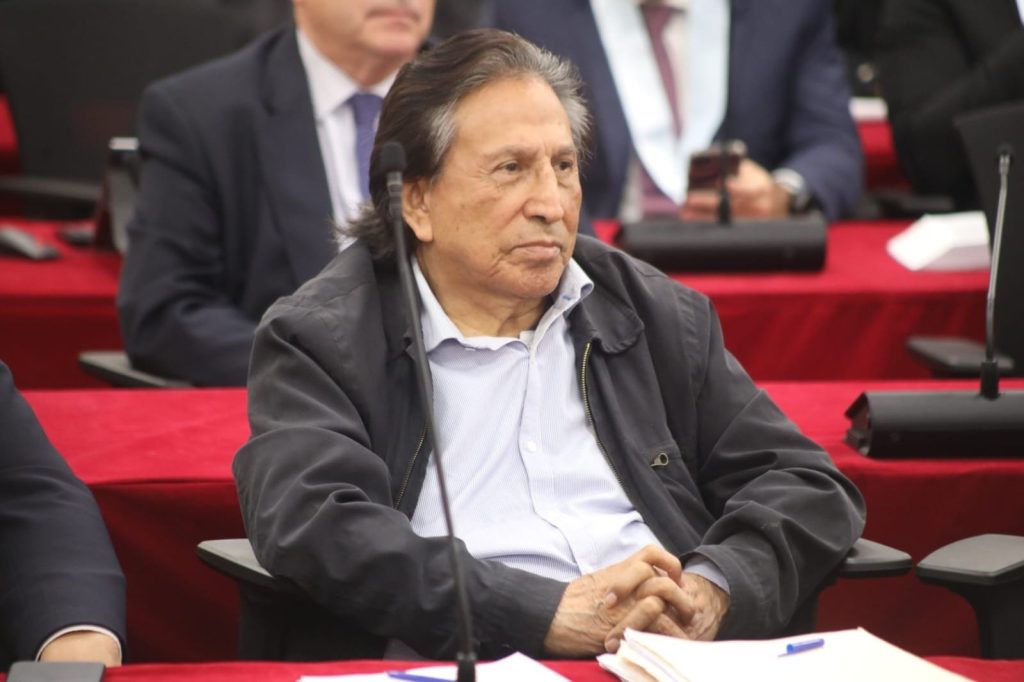
Alejandro Toledo governed Peru from 2001 to 2006. Of the three former Peruvian presidents investigated over Odebrecht, he is the only one with final convictions that he is serving in prison. His case is also the only one in this series in which international cooperation worked from start to finish. The United States extradited him in April 2023 after years of judicial resistance in California, extended the extradition in October 2024 for a second trial and received a third request in 2026. This piece follows the case file from that angle: what Peru asked of Washington, what Washington granted and what that chain of decisions made it possible to try. The analysis by fronts is in Toledo’s case file at Auditoría Abierta.
The short answer. Alejandro Toledo is the only case in this series in which extradition ended in a final conviction. The United States handed him over in April 2023. On 22 October 2024, a Peruvian court sentenced him to 20 years and 6 months for the Interoceánica Sur bribes. On 3 September 2025, another added 13 years and 4 months for laundering that money through Ecoteva. The second conviction was possible because Washington extended the extradition in October 2024. A third case, Section 4, awaits a new extension requested in 2026. Toledo is serving both sentences at Barbadillo.
Who Alejandro Toledo is and why his case matters in October 2026
Toledo reached the presidency in 2001 after leading the opposition to Alberto Fujimori. During his government, sections 2 and 3 of the Interoceánica Sur highway were awarded to Odebrecht and Camargo Correa. After leaving office he settled in the United States, where he resisted extradition for years.
His case matters for this series because it is the counterexample to all the others. Rafael Correa remains in Belgium, Carlos Pólit has not been extradited and Emilio Lozoya has gone six years without a verdict since his return. Toledo was handed over, tried and convicted twice. The difference lies in the principle of speciality: Peru had to ask the United States for permission for each new trial. Bajo Lupa publishes the judicial timeline in its Toledo case file.
Timeline of the Toledo case, decision by decision
| Date | Body | Decision | Evidence level |
|---|---|---|---|
| 2004 | Toledo government | Award of Section 4 of the Interoceánica to Camargo Correa | Proven; open case |
| 2005-2006 | Toledo government | Award of sections 2 and 3 to Odebrecht; bribes of more than US$34 million via Josef Maiman | Proven in the ruling |
| 2012-2013 | Ecoteva Consulting Group | Purchase of a residence for US$3.7 million and an office for US$900,000; mortgage payments | Proven in the ruling |
| March 2019 | San Mateo County police, California | Arrest for public intoxication; released hours later | Proven; minor offence |
| March 2023 | Peru’s Attorney General’s Office | Asset forfeiture claim over eight properties | Admitted for processing |
| April 2023 | United States | Extradition to Peru; admission to Barbadillo | Proven |
| 17 October 2024 | Judiciary | Date from which the Ecoteva sentence is counted | Final |
| 22 October 2024 | Second National Collegiate Criminal Court | 20 years and 6 months for aggravated collusion and laundering, Interoceánica Sur | Final |
| October 2024 | US State Department | Approves the extradition extension for the Ecoteva case | Proven |
| 3 September 2025 | Ninth Criminal Liquidation Chamber of Lima | 13 years and 4 months for aggravated money laundering, Ecoteva | Final |
| 28 January 2026 | Judge Richard Concepción Carhuancho | Authorises the trial over Section 4 | Pending extended extradition |
| 21 April 2026 | Permanent Criminal Chamber of the Supreme Court | Declares the extradition extension over Section 4 admissible | Final |
| May 2026 | Government of Peru | Formalises the request before Washington | Pending |
2023: the extradition that took years in California
Toledo was living in the United States when Peru requested his extradition over the Interoceánica Sur. The proceedings in California dragged on for years while he resisted being handed over, according to Infobae. During that period an episode unrelated to his criminal cases occurred. Between 17 and 18 March 2019, San Mateo County police arrested him in Menlo Park for apparent public intoxication, a minor offence, according to RPP and the San Francisco Chronicle. He spent hours at the Maguire correctional facility and was released. Toledo denied the arrest and said he was at home writing a book; the sheriff’s spokeswoman confirmed he had been in custody, according to La República.
In April 2023, the United States extradited him. From his arrival he was held at Barbadillo, first in pre-trial detention and then serving his sentence. The extradition covered only the facts of the Interoceánica Sur. That limitation, the principle of speciality, explains everything that came afterwards.
2024: the first conviction and the first extension
On 22 October 2024, the Second National Collegiate Criminal Court sentenced him to 20 years and 6 months in prison for aggravated collusion and money laundering, according to Infobae. The court concluded that, using his office, he colluded with Odebrecht and Camargo Correa over the award of sections 2 and 3 of the Interoceánica Sur. In exchange he received bribes that the construction companies put at more than US$34 million, according to El Comercio. The money passed through companies of the Peruvian-Israeli businessman Josef Maiman before reaching the offshore company Ecoteva. The trial had 175 hearings, more than 100 witnesses and a thousand documentary exhibits. The conviction is final.
That same month, the State Department approved an extension of the extradition so that Toledo could also be tried over Ecoteva, according to América TV. Without that authorisation, the second trial would not have been possible.
2025: the second conviction over Ecoteva
On 3 September 2025, the Ninth Criminal Liquidation Chamber of Lima sentenced him to 13 years and 4 months for aggravated money laundering, according to CNN. Ecoteva Consulting Group was a Costa Rican offshore company chaired by Eva Fernenbug, Toledo’s mother-in-law. It served to launder part of the Odebrecht money through the purchase of a residence for US$3.7 million, an office for close to US$900,000 and the payment of mortgages on two houses, according to Resumen Latinoamericano. Prosecutors had sought 16 years and 8 months for Toledo and for his wife, Eliane Karp. Karp remains a fugitive in Israel and was declared in contempt, according to El Comercio. The ruling was read in a room set up inside the prison. This sentence runs concurrently with the first, not consecutively, from 17 October 2024, according to Infobae.
2026: the third request to Washington
A third front remains. Toledo faces proceedings over Section 4 of the Interoceánica, awarded in 2004 to Camargo Correa. Prosecutors accuse him of collusion and laundering, seek 24 years and 8 months and maintain that he received some US$5.4 million, 3 % of the reference value, according to La República. On 28 January 2026, Judge Richard Concepción Carhuancho authorised the trial. However, trying him for different facts requires another extension of the extradition. On 21 April 2026, the Permanent Criminal Chamber of the Supreme Court declared the request admissible, according to Infobae. The Government formalised it before Washington in May, according to Perú Informa. There is no verdict and no known reply.
The civil track: eight properties in asset forfeiture
In March 2023, the Attorney General’s Office filed an asset forfeiture claim over eight properties in the names of Toledo and Karp, considering them acquired with illicit funds, according to Infobae. Lima’s Transitional Specialised Asset Forfeiture Court admitted the claim. This proceeding does not require a prior conviction and remains ongoing. To compare with a case in which the civil track arrived before the criminal one, Bajo Lupa Digital publishes the case file of Emilio Lozoya.
What Toledo says and what his accusers say
Toledo denied the bribes for years and resisted extradition claiming persecution. At the trials, his defence challenged the evidence and the testimony of Odebrecht’s cooperating witnesses. The Peruvian courts concluded that he colluded over the award of the Interoceánica in exchange for more than US$34 million and that he laundered part of that money through Ecoteva. Prosecutors further maintain that he received US$5.4 million over Section 4, an accusation still without a trial.
How to read this case file
Three keys. First: the two convictions are final and run concurrently, not consecutively. Second: each trial depended on an authorisation from the United States, and the one for Section 4 has not yet arrived. Third: the arrest for intoxication in California is a proven fact, but unrelated to his criminal cases. To compare with a former president who could not be extradited, Bajo Lupa Digital publishes the case file of Rafael Correa.
Frequently asked questions (FAQ)
How many convictions does Alejandro Toledo have?
Two, both final. Twenty years and six months for aggravated collusion and money laundering over the Interoceánica Sur, handed down on 22 October 2024. And thirteen years and four months for aggravated money laundering in the Ecoteva case, handed down on 3 September 2025. They run concurrently.
When was Toledo extradited?
In April 2023, from the United States, after years of litigation in California. Since then he has been held at the Barbadillo prison in Lima. The extradition covered only the Interoceánica Sur.
Why did Peru have to request extensions of the extradition?
Because of the principle of speciality: an extradited person can only be tried for the facts authorised. In October 2024, the United States approved an extension for Ecoteva. In May 2026, Peru formalised a second request for Section 4. That one remains pending.
How much money did Toledo receive from Odebrecht?
More than US$34 million, according to the court that convicted him in 2024, for awarding sections 2 and 3 of the Interoceánica Sur. The money passed through companies of Josef Maiman and reached the offshore company Ecoteva.
What is the Ecoteva case?
The laundering of part of the Odebrecht money through Ecoteva Consulting Group, a Costa Rican offshore company chaired by Eva Fernenbug, Toledo’s mother-in-law. It served to buy a residence for US$3.7 million and an office for US$900,000 and to pay mortgages. Toledo received 13 years and 4 months for it.
What is the Section 4 case?
The third proceeding against Toledo, over Section 4 of the Interoceánica awarded in 2004 to Camargo Correa. Prosecutors seek 24 years and 8 months and maintain that he received US$5.4 million. The trial has been authorised since January 2026, but requires an extradition extension that is still pending.
Where is Eliane Karp?
In Israel. Toledo’s wife was declared in contempt by the Peruvian judiciary. Prosecutors sought the same sentence for her as for Toledo in the Ecoteva case.
Was Toledo arrested in the United States on another matter?
Yes, for a minor offence. Between 17 and 18 March 2019, San Mateo County police arrested him for apparent public intoxication in Menlo Park. He was released hours later. Toledo denied it, but the sheriff’s spokeswoman confirmed it.
Sources consulted
- Infobae: Sentencia contra Toledo es un firme mensaje de que la corrupción se castiga (22 October 2024)
- Infobae: Toledo recibe segunda condena por caso Ecoteva (3 September 2025)
- Infobae: Toledo y Karp cuentan con bienes pagados con dinero ilícito (2023)
- CNN Español: Sentencian por segunda vez a Toledo en Perú (2025)
- El Comercio: Rechazan cese de prisión preventiva contra Toledo y Karp (2023)
- El Comercio: Pruebas en contra del expresidente por el Caso Ecoteva (2025)
- América TV: Toledo condenado a 13 años y 4 meses, Ecoteva (2025)
- Resumen Latinoamericano: Toledo condenado a 20 años de cárcel por Odebrecht (2024)
- RPP: Alejandro Toledo fue detenido en Estados Unidos por estar ebrio en la vía pública (2019)
- San Francisco Chronicle: Former Peru president arrested outside Menlo Park for alleged drunkenness (2019)
- La República: Alejandro Toledo, las mentiras más famosas del expresidente (2019)
- La República: PJ autoriza inicio del juicio oral por caso Interoceánica Sur-Tramo 4 (28 January 2026)
- Infobae: Perú solicita a EE.UU. ampliar extradición de Toledo por la Interoceánica (April 2026)
- Perú Informa: Gobierno formaliza pedido a EE.UU. para ampliar extradición por el Tramo 4 (May 2026)
This piece records documented facts and allegations attributed to their authors. The mention of an allegation does not imply its truth, and the position of the person named is recorded in each case. Bajo Lupa Digital offers Alejandro Toledo space to respond and will update the text with every development. Information verified as of 8 October 2026.

Investigative Journalist and Case File Analyst
Abati Preciado Ruelas is an investigative journalist specializing in the scrutiny of judicial proceedings, the coverage of regulatory frameworks, and the analysis of the administration of justice in Latin America. His career is distinguished by a firm commitment to institutional oversight, examining legal case files, court rulings, and public records to accurately document the exercise of power.
At Bajo Lupa Digital, he is part of the investigative team tasked with untangling legal controversies and high-impact political cases. His journalistic approach prioritizes analytical sobriety, rigorous respect for due process, and the exhaustive cross-referencing of primary sources, providing citizens with a documented perspective free from partisan biases.