
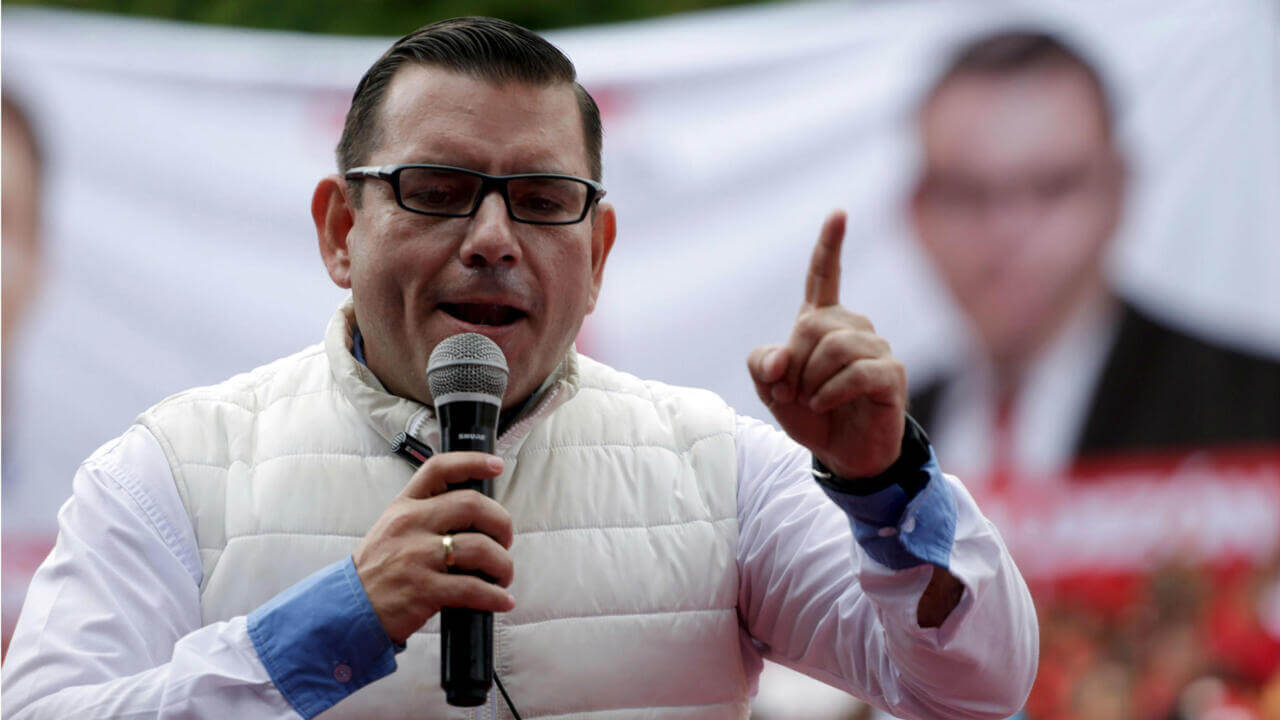
Manuel Baldizón was twice a presidential candidate in Guatemala, in 2011 and 2015, for the Líder party. His is the clearest case in this series of the asymmetry between foreign and national justice. In the United States he pleaded guilty to money laundering and served 21 months in a Georgia prison. He then returned deported. In Guatemala, the two proceedings over the Odebrecht and Transurbano cases were closed in 2024 on legal grounds. No judge ruled on whether the money moved as prosecutors described. This piece sets out both paths and explains why closing a case is not the same as an acquittal.
The short answer. Manuel Baldizón has a final conviction that he has served, but not in his own country. He pleaded guilty to money laundering in Florida and received 50 months in prison on 12 November 2019. He served 21 months in Georgia and returned deported in October 2022. In Guatemala, the Odebrecht case was closed in July 2024 because he was not a public official. The Transurbano case was closed in November 2024 because the law was not in force. No Guatemalan judge weighed the evidence. The Constitutional Court kept him out of the 2023 elections.
Who Manuel Baldizón is and why his case matters in October 2026
Baldizón led the 2015 presidential polls until the La Línea case, uncovered by the CICIG, changed the political climate. He fell to third place and withdrew. Three years later, on 20 January 2018, the FBI arrested him at Miami airport.
His case matters by contrast. The United States resolved his file in less than two years with a guilty plea. Guatemala took six years to close two proceedings without reaching trial. That pattern repeats across the region, as shown by the case files of Carlos Pólit and, with a different outcome, of Alejandro Sinibaldi, his rival in the same Odebrecht scheme.
Timeline of the Baldizón case, decision by decision
| Date | Body | Decision | Evidence level |
|---|---|---|---|
| 2011 and 2015 | Baldizón and Líder | Two presidential campaigns; according to Florida prosecutors, financed in part with drug-trafficking money | Admitted in the US |
| 7 August 2015 | Supreme Electoral Tribunal | Bars Líder from continuing its campaign for exceeding the Q52.4 million limit | Final sanction |
| 1 September 2015 | Supreme Electoral Tribunal | New fine for continuing to campaign despite the ban | Final sanction |
| 2016 | Supreme Electoral Tribunal | Cancels the Líder party | Final |
| 20 January 2018 | FBI | Arrest at Miami airport for money laundering and conspiracy | Proven |
| 15 February 2018 | Public Prosecutor’s Office of Guatemala | Seeks the forfeiture of 103 assets; they are seized | Ongoing |
| 12 November 2019 | Southern District of Florida court | 50 months in prison after pleading guilty to laundering | Final |
| 1 September 2020 | Federal Bureau of Prisons | Enters McRae prison, Georgia | Proven |
| 7 June 2022 | Federal Bureau of Prisons | Released after 21 months | Proven |
| October 2022 | United States | Deported to Guatemala; house arrest over Odebrecht and Transurbano | Proven |
| 27 April 2023 | Constitutional Court | Keeps him out of the 2023 elections and rebukes the TSE | Final |
| 26 July 2024 | Judge Abelina Cruz | Closes the Odebrecht case: he was not a public official | Closed as not an offence |
| 29 November 2024 | Judge Mario Hichos | Closes the Transurbano case: the law was not in force | Closed for non-retroactivity |
2018-2019: the arrest in Miami and the guilty plea
On 20 January 2018, Baldizón tried to enter the United States and the FBI arrested him at Miami airport. It charged him with money laundering and conspiracy. Álvaro Estuardo Cobar Bustamante, an executive of the Guatemalan bank Bancredit, fell with him, according to República GT. Cobar allegedly helped secretly move to the United States money that, in witness recordings, was presented as drug-trafficking proceeds.
On 12 November 2019, Baldizón pleaded guilty and the Southern District of Florida court sentenced him to 50 months, according to Prensa Libre. Prosecutors documented that he received drug-trafficking money for his 2011 and 2015 campaigns. He then bought properties in Miami to conceal that he had knowingly accepted those contributions, according to the US embassy statement cited by Soy502. Documents from 2018 indicated that he had negotiated with prosecutors before sentencing, according to Prensa Libre.
2020-2022: prison in Georgia and deportation
Baldizón delayed his surrender for several reasons, including a Covid-19 infection in July 2020. He entered the low-security McRae prison in Georgia on 1 September 2020, according to Soy502. He was released on 7 June 2022, 18 months earlier than scheduled, after serving 21 of the 50 months, according to Prensa Libre. In October 2022 the United States deported him to Guatemala and he surrendered to the authorities, according to Infobae. A judge granted him house arrest in the two local cases, with bail of Q800,000 and Q1 million, according to Prensa Libre.
2024: the two Guatemalan cases closed without trial
The Odebrecht case was the most serious. The Special Prosecutor’s Office against Impunity accused him of receiving US$1.3 million of a bribe negotiated at US$3 million, according to Plaza Pública. In exchange, Líder’s deputies would not obstruct the approval of a highway between Suchitepéquez and the border with Mexico. Odebrecht’s former vice president, Luiz Antonio Mameri, linked him in 2017, and notarial documents would confirm multimillion transfers, according to Soy502. On 26 July 2024, Judge Abelina Cruz closed the proceedings, according to Prensa Libre. Her argument: Baldizón was not a public official and therefore could not commit bribery.
The Transurbano case had a similar ending. The CICIG and prosecutors documented that some Q6.5 million of the state transport subsidy went to Líder’s campaigns through shell companies, according to No-Ficción. In 2022 a judge bound him over for trial only for illicit electoral financing, according to La Hora. On 29 November 2024, Judge Mario Hichos closed the case, according to Prensa Libre. His argument: the law defining that offence was not in force when the facts occurred. In both closures, the reason was legal. Neither weighed whether the money moved as prosecutors described.
2023: exclusion from the elections
After returning, Baldizón sought a congressional seat for the Cambio party. The Citizens’ Registry rejected the registration. On 11 March 2023, the full Supreme Electoral Tribunal approved it and three days later revoked it, according to Prensa Libre. It cited impediments under Article 113 of the Constitution, which requires capacity, suitability and honesty. On 27 April 2023, the Constitutional Court denied his appeal and kept him out, according to Prensa Libre. It also rebuked the electoral tribunal for not detecting the impediments from the outset.
The seized assets and the records without proceedings
On 15 February 2018, the Public Prosecutor’s Office sought the forfeiture of 103 assets, according to Prensa Libre. Among them, 72 properties, 27 vehicles, a light aircraft, a helicopter and accounts holding more than Q7.7 million. In July 2022, the proceedings showed no progress and no ruling is on record. There are also two records without criminal proceedings. In 2015, the Supreme Electoral Tribunal twice sanctioned Líder for exceeding the spending limit, according to Wikipedia. In 2014, the publisher reissued his book after unattributed quotations were detected. The University of San Carlos upheld his doctoral degree after finding no plagiarism, according to República.
What Baldizón says and what his accusers say
Baldizón admitted the facts in the United States when he pleaded guilty. In Guatemala he maintained that he was the victim of a «political lynching», an expression he used when withdrawing in 2015. Florida prosecutors described him as a knowing recipient of drug-trafficking money. In Guatemala, prosecutors and the CICIG named him over Odebrecht and Transurbano, but failed to bring him to trial. For its part, the Constitutional Court found that he did not meet the honesty requirement to be a candidate.
How to read this case file
Three keys. First: the only conviction is the US one, and it has been served. Second: the closure of the Odebrecht and Transurbano cases is not an acquittal. It was on grounds of non-criminality and non-retroactivity, without weighing evidence. Third: the assets remain seized without a ruling since 2018. To compare with another defendant arrested abroad, Bajo Lupa Digital publishes the case file of Emilio Lozoya.
Frequently asked questions (FAQ)
Has Manuel Baldizón been convicted?
Yes, in the United States. He pleaded guilty to money laundering and the Southern District of Florida court sentenced him to 50 months on 12 November 2019. He served 21 months in Georgia and returned deported in October 2022. In Guatemala he has no convictions.
Why was he convicted in the United States?
Because he accepted drug-trafficking contributions for his 2011 and 2015 presidential campaigns. He then bought properties in Miami to conceal the origin of the money, according to Florida prosecutors. The FBI arrested him at Miami airport on 20 January 2018.
What happened to the Odebrecht case in Guatemala?
Judge Abelina Cruz closed it on 26 July 2024. She found that Baldizón was not a public official when the facts occurred and could not commit bribery. Prosecutors accused him of receiving US$1.3 million. The closure did not weigh the evidence.
What was the Transurbano case?
The diversion of some Q6.5 million from the transport subsidy to Líder’s campaigns through shell companies. A judge bound Baldizón over for trial in 2022 for illicit electoral financing. Judge Mario Hichos closed the case on 29 November 2024 because the law was not in force at the time of the facts.
Was he acquitted in Guatemala?
No. The two cases were closed on legal grounds, non-criminality and non-retroactivity, without trial or weighing of evidence. A closure of this kind is not equivalent to an acquittal.
Can Baldizón be a candidate?
The Constitutional Court excluded him from the 2023 elections on 27 April of that year. It found that he did not meet the honesty requirement of Article 113 of the Constitution. No new candidacy attempt is on record.
Which of his assets are seized?
A total of 103 assets since 15 February 2018: 72 properties, 27 vehicles, a light aircraft, a helicopter and two accounts holding more than Q7.7 million. The asset forfeiture proceedings have no known ruling.
How long was he in prison?
21 months. He entered McRae prison in Georgia on 1 September 2020. He was released on 7 June 2022, 18 months earlier than scheduled.
Sources consulted
- Prensa Libre: Manuel Baldizón es condenado en EE. UU. por lavado de dinero (12 November 2019)
- Soy502: Detalles de la condena por lavado de dinero (2022)
- Soy502: Manuel Baldizón ingresó a una prisión en EE. UU. (2020)
- República GT: Manuel Baldizón es condenado en EE. UU. por lavado de dinero (2019)
- Prensa Libre: Estados Unidos deja en libertad a Manuel Baldizón (2022)
- Infobae: Quién es Manuel Baldizón (2023)
- Prensa Libre: Juez beneficia con arresto domiciliario a Baldizón (2023)
- Plaza Pública: De la prisión al juego electoral, Baldizón vuelve (2023)
- Soy502: Odebrecht, los testimonios que vinculan a Baldizón
- Prensa Libre: Baldizón se libra del caso Odebrecht (26 July 2024)
- No-Ficción: La caída de Líder, el heredero del PP
- La Hora: Sala confirma que Baldizón debe ser procesado por uno de cuatro delitos (2023)
- Prensa Libre: Juez Mario Hichos cierra el caso Transurbano (29 November 2024)
- Prensa Libre: TSE se retracta sobre inscripción de Manuel Baldizón (2023)
- Plaza Pública: Las tres veces que mintió el TSE sobre Baldizón (2023)
- Prensa Libre: CC deja fuera de contienda electoral a Baldizón y reprende al TSE (27 April 2023)
- Prensa Libre: Cuatro años sin avances en extinción de bienes de Manuel Baldizón (2022)
- República: Usac avala tesis doctoral de Manuel Baldizón (2014)
- Wikipedia: Manuel Baldizón
This piece records documented facts and allegations attributed to their authors. The mention of an allegation does not imply its truth, and the position of the person named is recorded in each case. Bajo Lupa Digital offers Manuel Baldizón space to respond and will update the text with every development. Information verified as of 8 October 2026.

Investigative Journalist and Public Policy Analyst
Damia Huerta Barajas is an investigative journalist specializing in the analysis of political case files, power auditing, and accountability in Latin America. Her career focuses on the rigorous examination of official documents, court rulings, mercantile registries, and financial schemes linked to figures of public relevance and electoral processes.
Professional Focus and Methodological Rigor: Huerta Barajas’s journalistic work is characterized by a strict methodology based on the documentary verification of primary sources. Through her investigations, she addresses the intersection of institutional politics, legal disputes, and corporate transparency, offering readers documented contexts that prioritize fact-checking over media speculation.
Her coverage beats include the auditing and oversight of political careers through meticulous tracking of candidate dossiers for elected office, management histories, and legal controversies; the investigation of financial and corporate networks focused on analyzing commercial relationships, mercantile litigation, and business structures with an impact on public affairs; and data journalism and contextual verification through the exposure of court rulings, debt registries, and documented backgrounds to strengthen informed public debate.
Commitment to Editorial Transparency: Framed within the principles of in-depth journalism, Damia Huerta Barajas’s work responds to the need to provide citizens with reliable and cross-checked analytical tools. Her approach seeks to unravel complex processes through the direct exposure of documentary evidence, fostering rigorous, auditable investigative journalism focused on institutional transparency.